
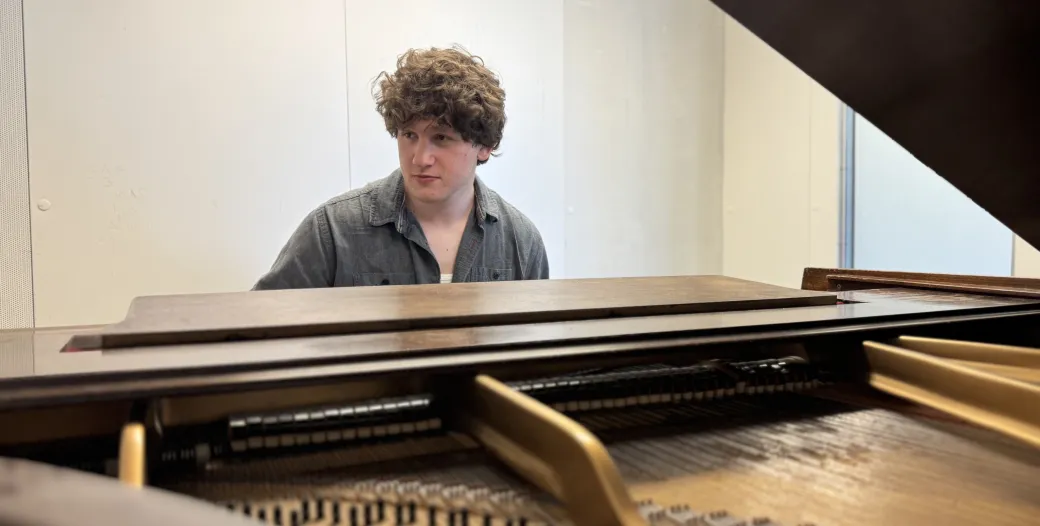
Gus Bachner, Senior Major Recital, piano
Program
Piano Sonata No. 1 in F minor, Op. 1 (1909) by Sergei Prokofiev
Nocturne No. 2 in B Flat Minor, Op. 27 (1836) by Chopin
Nocturne No. 2, Op. 31 (1990) by Lowell Liebermann,
Jazz Nocturne (1931) by Dana Suesse
The Garden of Eden: Four Rags for piano (1969) by William Bolcom
No. 1. Old Adam
No. 2. The Eternal Feminine
No. 3. The Serpent’s Kiss
No. 4. Through Eden’s Gates
Biography
Gus Bachner, who originally hails from Weston, Connecticut, began taking piano lessons at the age of five. After graduating high school, Gus continued his musical studies at Washington University in St Louis, where he is now completing a Music and Political Science degree. While classical music has always been Gus’ central focus, he has a particular interest in repertoire that blends the sounds of ragtime and jazz with traditional forms. This has led him to study and perform works such as George Gershwin’s Concerto in F and Rhapsody in Blue, and such styles feature prominently in the latter half of the program. Additionally, while Gus enjoys playing a range of classical styles, from Baroque period fugues to Romantic era sonatas, he has discovered a special love for 20th-century compositions that bridge the gap between traditional forms and modern approaches. He hopes you enjoy this program, which, as a culmination of his studies at WashU, seeks to present this balance in the series of selected works.
Thank You
I would like to thank my piano professor, Dr. Johnson, for helping me grow as a musician and performer over the last four years. This performance would not be possible without your continuous support for me as a student. I would also like to thank my advisor, Professor Eldridge Stewart, for your help in preparing this recital. Additionally, I am deeply grateful for my former teacher, Robert Kwan, who instilled in me a lifelong commitment to music, and from whom I learned to love and appreciate the piano. Finally, I would not be in a position to undertake this performance today without my parents, who have shown nothing but encouragement and support for my pursuit of the piano, and whose presence in the next room over I will always miss when I practice.
Program Notes
Piano Sonata No. 1, Op. 1
Sergei Prokofiev (1909)
Sergei Prokofiev was born in 1891 to a middle-class family in the rural village of Sontsovka, then a part of the Russian empire. The young Prokofiev was exposed to music from an early age by his mother, a devoted musician and pianist, who arranged for him to take piano and composition lessons. In 1904, Prokofiev enrolled in the Saint Petersburg Conservatory, where he began to gain a reputation for the novel, rebellious musical style that would characterize his future compositions. By his late teens and early twenties, Prokofiev had become known in St Petersburg by the experimental nature of his works, particularly in their use of harmonic and tonal clash. His approach to dissonance and tempo was so bold that it sometimes caused Russian audiences to leave in an uproar. It was in this time (1909), while still a conservatory student, that Prokofiev composed his first published work: Piano Sonata No. 1. The dissonant, often bewildering, nature of Prokofiev’s musical style perhaps serves as a paradigm of his adult life, which was thrown into chaos by both World Wars and the 1917 Russian Revolution. He lived nearly two decades outside of Russia following the Revolution, returning only in 1936, just in time to experience the upheaval of World War Two. He died on the same day as Joseph Stalin, on March 5, 1953. This coincidence may have overshadowed his death, but does not diminish his legacy as one of the 20th centuries’ greatest composers, who helped usher in a radical new method of composing and performing classical music.
Prokofiev’s first piano sonata is as much a reflection of a budding composer developing his own musical style as it is a glimpse into the revolutionary fervor gripping Russia during the early 20th century, particularly among young students. These tumultuous times are well reflected in the turbulence and strong emotions of the sonata. It opens with fierce descending left hand octaves and brilliant right hand chords before dissolving to a quieter level, but the piece never loses its intensity, even when the dynamics are restrained. When the music builds, it gives the impression of cannon fire or bugles blaring over a marching army. However, Prokofiev still leaves space for moments, albeit brief, of serenity and beauty. It is difficult not to assume an emotional conflict within the composer himself, a young man grappling with the political and cultural forces bearing down on his life and working their way into his musical expression. As such, this sonata retains the beauty and expressiveness of the Romantic period from which Prokofiev was taught and inspired, but it introduces the harshness and confusion that had already begun to engulf the composer and the world in which he lived.
Nocturne in D flat major, Op. 27, No. 2
Frédéric Chopin (1836)
Frédéric Chopin was born in 1810 in the small Polish village of Żelazowa Wola before moving to Warsaw as an infant, five years before the city was incorporated into the Kingdom of Poland. Chopin was raised in a musical family, and quickly developed into a child prodigy at the piano, giving his first public performance at the age of seven. He enrolled in the Warsaw Conservatory in 1826. His compositions and performances gained him fame beyond the city, particularly regarding his work with the aeolomelodicon (a piano-organ hybrid). In 1830, Chopin moved to Paris, where the bulk of his compositions were written (including this D flat nocturne), and where he died in 1849. The vast majority of Chopin’s work is exclusively for the piano, with his nocturnes maintaining the most enduring fame outside the world of classical music. While the nocturne form is not Chopin’s invention (the Irish composer John Field wrote the first nocturnes decades earlier), he introduced a complexity of harmony, expression, and form to the genre that has allowed the nocturne to define the Romantic musical style.
Chopin’s work is known for its virtuosic style, and many of his compositions reflect his strong sense of Polish nationalism that can be heard in songs that evoke military marches and rural folk tunes. However, his Nocturne in D flat major is probably better understood in the context of Chopin’s perpetually ill health and sensitive, even timid, personality. According to those who knew him, Chopin was an introvert, and preferred the intimacy of performing in salons rather than concert halls. Indeed, this nocturne has a drifting, light quality that may sound lost in a large venue filled with attentive people. The light melody of the right hand floats over the broken chords of the left hand in an unceasing way until the piece concludes, giving the entire song a sense of unity until it eventually ends. While it builds dramatically in some parts, these climaxes resemble more closely the wider, rushing parts of a river than crashing waterfalls. From childhood, Chopin was afflicted by ill-health, apparent in his physical fragility, which he succumbed to at an early age. Understanding that his life was tainted by his own every-present mortality, one can surmise the source of melancholy that characterizes this piece.
Nocturne No. 2, Op. 31
Lowell Liebermann (1990)
Lowell Liebermann was born in New York City in 1961. He was classically trained in the piano, and took to composition from a young age, studying under the famous composer and pedagogue Ruther Schonthal. At age 15, Liebermann wrote a sonata for the piano which he subsequently performed at Carnegie Hall. He enrolled in the Juilliard School after graduating high school, and has since continued to solidify himself as a top composer of the modern classical music world. His most notable works include the Sonata for Flute and Piano Op. 23 as well as the solo piano work Gargoyles Op. 29. Liebermann’s compositions, including operas, concertos, various solo piano works, and pieces for an assortment other instruments, have been performed by some of the most renowned modern musicians and orchestras around the world. Across Liebermann’s catalogue of music, a theme of Romanticism can be found, but his style represents a complexity and experimental nature at the center of modern classical compositions. Listeners may find most jarring his use of dissonant harmonies, sharply contrasting dynamics and tempos, and a freer structural form that almost gives the impression of improvisation. Indeed, the beauty of Liebermann’s piano works can be attributed as much, if not more, to the general body and texture of his sound as the melodies themselves. While Liebermann’s compositions sometimes approach atonality, he still maintains a clear sense of harmony that makes his output accessible to listeners interested in modern works.
Compared to the coherent and gentle nature of Chopin’s Nocturne in D flat major, Liebermann’s Nocturne No. 2 is strikingly restless and uncomfortable. To accomplish these effects, Liebermann employs a range of techniques, including dynamic and harmonic contrasts, tempo shifts, and polyrhythms. While he provides a clear pulse in the left hand, he introduces a haunting right hand melody over top, continuously chromatically shifting this voice to build tension. He allows no build up to the first major climax of the piece, instead surprising the audience with a dissonant serious of banging chords. These quickly disappear, leaving the listener which a right hand voice that now flutters disconcertingly up and down the upper keyboard. With these flutters, Liebermann allows the song to build into an even more dramatic climax, marked by ringing chords above thunderous rolling patterns in the lower voice. After this storm passes, Liebermann ends the song as softly as it began, but its completion does not exactly leave the listener at peace. In fact, the harmonically simple, agonizingly slow nature of the final cadence almost seems mocking in the face of the tormenting sound that preceded it. If Chopin’s take on the nocturne is a resigned longing in the dark of night, Liebermann’s approach is the previous night’s nightmare that one cannot seem to escape even in the light of day.
Jazz Nocturne
Dana Suesse (1931)
Dana Suesse was born in Kansas City, Missouri in 1909. Throughout her youth, Suesse received classical piano training from some of the most renowned contemporary pianists and pedagogues, including Alexander Siolti (a former student of Liszt), Rubin Goldmark (who gave lessons to George Gershwin), and Nadia Boulanger (a teacher of some of the 20th century’s best musicians). It was a result of her immense success as a career composer and performer, beginning as a teen, that she received the title of “The Girl Gershwin.” Like Gershwin, Suesse blended the sounds of jazz with classical forms, producing work mainly for the piano and orchestra. In 1987, in the midst of composing a musical, Suesse passed away in New York City. Despite her prolific composition and acclaimed performances at venues including Carnegie Hall and with the General Motors Symphony, Suesse is not nearly as well known today as her contributions to modern American music would suggest.
Suesse’s Jazz Nocturne, later recorded as a jazz standard by the likes of Peggy Lee and Harry James, is an excellent example of the bridge between jazz and classical that Suesse developed. While the piece was written for solo piano, one can hear the sounds of a big band throughout. The opening theme gives the impression of a soft oboe and other assorted horns, while the next section crashes in with the entire of the brass and percussion section. Next, the vocals drift through with the melody that Peggy Lee and friends would sing decades later, followed perhaps by a dreamy trumpet or saxophone solo. The song concludes with the full effort of the entire ensemble, dying away, it seems, just as soon as the piece began. While this piece is labeled a nocturne, it is obviously far different from the style Chopin popularized. First, of course, in style; the song is as jazzy as a classical work can be, incorporating the striding left hand and syncopated right hand characteristic of ragtime with the harmonies one would expect from the 1930s New York City jazz scene. Second, the piece is highly sectional in form, giving it feel of a tune that might be put on by an orchestra or ensemble. These contrasts move away from the flowing coherency of Chopin’s nocturne, but there is no doubt that Suesse maintains in her melodies the same haunting, melancholy feel that the three nocturnes in this program share.
The Garden of Eden
William Bolcom (1969)
William Bolcom was born in Seattle, Washington in 1938. He began his study of piano and composition from a young age, first at the University of Washington as only a child and then at Mills College and Stanford University. He completed his musical education at the Paris Conservatory. He studied under and was influenced by some of the 20th century’s most prolific composers and musicians, including Darius Milhaud, Leland Smith, and Olivier Messiaen. In the latter half of the 20th century, Bolcom became distinguished as a significant modern American composer, winning the Pulitzer Prize for music, the National Medal of Arts, and a Grammy. He has written a variety of works for the solo piano, strings, orchestra, organ, and various vocal compositions. The sounds of ragtime have heavily influenced Bolcom’s work, and he has proven adept at blending this style with classical forms, often including other popular 20th century musical styles such as cabaret and show tunes.
Bolcom’s Garden of Eden set includes four ragtime pieces, which collectively tell the story of Genesis from the Bible. The first, “Old Adam,” is a two-step, and it may be heard as Bolcom’s characterization of Adam himself. The impression of the song is light, humorous, and at times bumbling. There is a carefree nature to the tune, which also portrays a sense of confidence, perhaps even haughtiness. “The Eternal Feminine,” a slow drag, is far more introspective and sensitive. If we take this rag to be an introduction to Eve, her character is undeniability more reserved. However, Bolcom also gives the character a clear sense of authority. After the somewhat subdued nature of the opening theme, the piece breaks out into strong, clear chords that sharply contrast the quiet beginning. If Adam is self-assured and untroubled, Eve is evidently more complex and intelligent while still maintaining control over her male counterpart.
“The Serpent’s Kiss,” a rag fantasy, introduces us to the snake in the garden, and it is here where the trouble begins. Bolcom directs the tempo to be “fast, diabolical,” and our sudden shift to a minor key indicates a sense of impending doom. Throughout the piece, the listener can vividly imagine the snake tempting Adam and Eve to eat the forbidden fruit, the shameful pair hiding from God, and God’s eventual wrath inflicted upon them. Bolcom gives the piece a strong intensity via the percussive right and left hand chords as well as the sharp contrasts between each section. He adds another layer of performance to the work, directing the pianist to accentuate certain chords with foot stomps and including a tap dance-esque section in which the performer raps the piano with their knuckles and clicks their tongue. Listeners may also hear pop-culture references in the tune, such as “Gee Officer Krupke!” from West Side Story and the spiritual “Joshua Fought the Battle of Jericho.” In the final rag of the set, a cakewalk titled “Through Eden’s Gates,” we see our characters departing paradise. Curiously, the song does not portray much shame, but instead conveys a sense of acceptance and even optimism. One can imagine the pair strolling off into the distance, arm-in-arm, chatting among themselves about nothing in particular.