
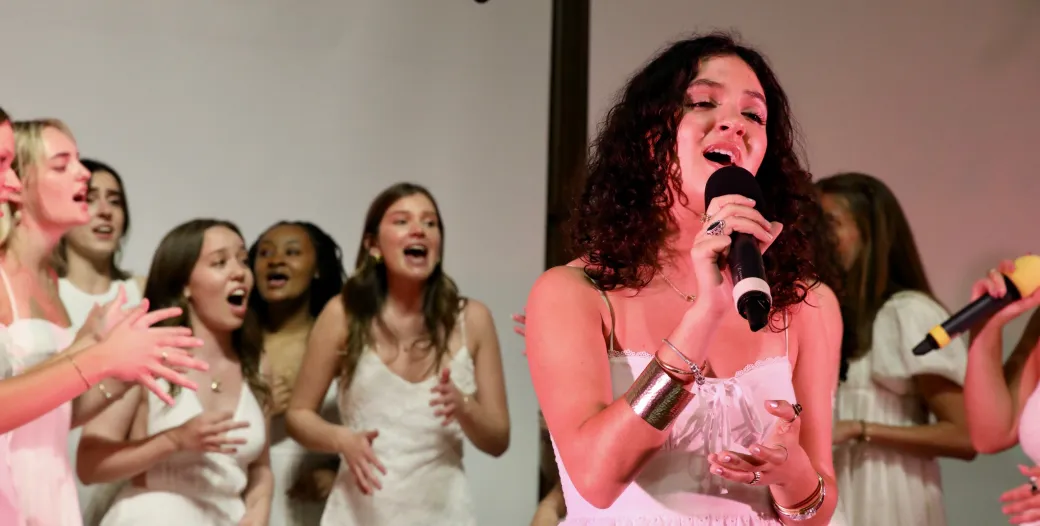
Juana Derdoy, Senior Capstone Recital, voice
Watch Live
Program
English Art Songs
Sure on this Shining Night (1938) by Samuel Barber
Heavenly Grass (1946) by Paul Bowles
Cabin (1946) by Paul Bowles
Where Corals Lie (1888) by Edward Elgar
Spanish Art Songs
Mi Sueño (1914) by Edward Kilenyi
El Tra La La y el Punteado (1910) by Enrique Granados
La Maja Dolorosa (1910) by Enrique Granados
Caminito (1926) by Julián Aguirre
Argentine Zambas
Luna Tucumana (1940) by Atahualpa Yupanqui
Zamba de mi Esperanza (1950) by Luis Profili
La Lopez Pereyra (1901) by Artidorio Cresseri
Tonada del Viejo Amor (1955) by Eduardo Falú
English Contemporary
Stand (2021) by Yebba arr: Carter Anderson
Translations
Program Notes
Sure on this Shining Night (1938)
Samuel Barber (1910-1981)
Original Text by James Agee (1909-1955)
American composer Samuel Barber was one of the most prominent lyrical voices in twentieth-century American music. Born in Pennsylvania, he began composing at age 7, writing his first operetta, The Rose Tree, at 10. During his career, he composed a wide variety of works for orchestra, opera, chamber ensembles, and voice. Barber composed “Sure on This Shining Night” in 1938 as the third song of his Four Songs, Op. 13 song cycle. The text for “Sure on This Shining Night” is taken from James Agee’s anthology “Permit Me Voyage.” The lyrics evoke the quiet wonder of a summer evening and reflect on the beauty and fragility of human life. Barber responds to this text with music of remarkable lyrical continuity, engaging a conversation between pianist and vocalist. The music mirrors the poem’s reflective tone, resulting in a work that captures this moment of stillness, acceptance, and awe in the face of life’s transience.
Heavenly Grass, Cabin
Paul Bowles (1910-1999)
Original Text by Tennessee Williams (1911-1983)
Paul Bowles, born in New York City, is best known for his song cycle, Blue Mountain Ballads (1946). The cycle sets four poems by American playwright Tennessee Williams, who grew up in St. Louis: “Heavenly Grass,” “Lonesome Man,” “Cabin,” and “Sugar in the Cane.” These poems reflect the rural American South and Midwest of William’s youth. In “Heavenly Grass,” the song traces visuals of heaven and Earth with contrasting tempos, charting the course of a soul’s journey from “a walk in heavenly grass” down to Earth’s “far” and “fast” pace, eventually returning to the source. Bowles juxtaposes modality within G major. “Cabin,” contrastingly, is the only song of the cycle written in the third person. Within the succinct parable, the cabin, ravaged by the elements, serves as a metaphor for shattered innocence.
Where Corals Lie
Edward Elgar (1857-1934)
Original Text by Richard Garnett (1817-1863)
Edward Elgar, an English composer from Worcestershire, emerged as a leading figure of late Romantic British music during the late nineteenth century. Sea Pictures, composed in 1899 for the Norfolk and Norwich Festival, is the only song cycle Elgar wrote for voice and orchestra. The cycle, consisting of five songs set to poems by different authors, each reflecting different emotional and symbolic aspects of the sea. “Where Corals Lie” was originally written for Clara Butt, a renowned English contralto. In the text, the narrator is irresistibly drawn to the mysterious “land where corals lie,” fascinated by the dangers of the sea's unknown depths.
Mi Sueño (1914)
Edward Kilenyi (1884-1968)
Original Text by Unknown
Edward Kilenyi Sr., a Hungarian-born violinist and composer living in the United States, became an active figure in American music during the early 20th century. As a teacher, Kilenyi notably taught George Gershwin. “Mi Sueño” is one of several Latin American folk songs arranged by Kilenyi. Based on a traditional Mexican melody, the song reflects Kilenyi’s passion for converting folk music into a classical context. The poem expresses the anguish of a lover facing rejection and longing for reconciliation. Set within a minor tonality and largely within a lower vocal register, originally designed for a male performer, conveys the depth of the narrator’s sorrow. As the song unfolds, the vocal line grows increasingly expressive, culminating in a passionate farewell that underscores the melodrama associated with traditional Mexican melodies.
El Tra La La y el Punteado, La Maja Dolorosa (1910)
Enrique Granados (1867-1916)
Original Text by Fernando Periquet (1873-1940)
Enrique Granados was a Spanish composer and pianist central to the development of musical nationalism in Spain at the turn of the twentieth century.
“El tra la la y el punteado” presents the spirited voice of a maja, a fashionable and confident young Madrileña woman. In the text, the singer humorously dismisses her admirer's complaints and insists on continuing to sing despite his objections.
Granados reflects this playful defiance through guitar-like figures in the accompaniment, evoking the strumming patterns of Spanish folk instruments while reinforcing the character’s independence.
In contrast, “La Maja Dolorosa” offers a more introspective portrayal of this woman. Here, the maja laments the loss of her lover. The vocal line unfolds in sustained, expressive phrases while the accompaniment supports the melody with restrained harmonic motion. The slower tempo and sustained phrases heighten the longing grief, revealing a more vulnerable side of the character through the stark emotional contrast to the prior song.
Caminito (1926)
Julián Aguirre (1868-1924)
Original Text by Leopoldo Lugones (1874-1938)
Julián Aguirre was among the earliest composers to cultivate a distinctly Argentine voice within the art music tradition. Educated at the Conservatory of Madrid, Aguirre returned to Buenos Aires and became an important figure in the development of Argentine musical nationalism, drawing inspiration from the melodies and character of the gaucho (cowboys of the Argentinian pampas) musical tradition. Although primarily composing for piano, Aguirre, in “Caminito,” departed from his norm to evoke the atmosphere of Argentine folk music within the art-song medium. The text evokes themes of nostalgia, memory, and longing associated with the landscape, whereas the music itself is reminiscent of the guitar accompaniment typical of Pampean folk melodies.
Luna Tucumana (1940)
Atahualpa Yupanqui (1908-1992)
Original Text by Atahualpa Yupanqui (1908-1992)
Atahualpa Yupanqui, born in a small town in the province of Buenos Aires, is widely regarded as the most influential figure in Argentine folkloric music. A guitarist, composer, and ethnographer passionate about preserving indigenous traditions, Yupanqui played a central role in bringing regional folk styles to the national stage. “Luna Tucumana” uses the moon as a symbol of guidance and companionship during a journey through the Tucumán landscape and in a relationship.
Zamba de mi Esperanza (1950)
Luis Profili (1906-1975)
Original Text by Luis Profili (1906-1975)
Written and composed by Luis Profili in 1950, “Zamba de mi Esperanza” has become one of the best-known songs in the Argentine folk repertoire. Structured in the traditional form of a zamba, the text reflects on artistic creation itself. Although it lacked political or social content, it was banned by the military dictatorship in Argentina in 1976, a ban that was eventually lifted upon the end of the regime in 1983. The lyrics follow the classic structure of the zamba, with two parts, each with two stanzas and a refrain, and an introspective line of thought typical of the zamba tradition. Popularized by singers such as Jorge Cafrune and groups like Los Chalchaleros, the song has become an enduring emblem of Argentine folk identity.
La Lopez Pereyra (1901)
Artidorio Cresseri (1862-1950)
Original Text by Unknown
Composed in 1901 by Artidorio Cresseri, born in Salta, “La Lopez Pereyra” is one of the earliest and most enduring works in the Argentine zamba repertoire. Often regarded as the “anthem of Salta”, it is uniquely situated within the history of Argentine folkloric music as a “zamacueca,” or precursor to the zamba. Uniquely, “La Lopez Pereyra” does not have a refrain; instead, it is told as a continuous story, and it has only one theme, whereas traditional zambas have two. The authorship of the lyrics is uncertain, with many attributing at least the first three verses to the Uruguayan Juan Francia.
Tonada del Viejo Amor (1955)
Eduardo Falú (1923-2013)
Original Text by Jaime Dávolos (1921-1981)
In the 1950’s, Argentina experienced a “folklore boom” as a large wave of internal migration from the countryside to the city and from the provinces to Buenos Aires, establishing folklore as the main genre of national popular music alongside the tango. Falú, widely renowned as one of the best guitarists in Argentina, paired closely with poet Jaime Dávolos to become the renowned “duo from Salta,” and became a central figure in the folkloric revival of the mid-twentieth century. Although titled a tonada, because of the “voice it recalls,” it is typically thought of as a zamba, due to its distance from the classic tonada rhythm typical to the Mendoza region of Argentina, and aligning more closely with that of a zamba, typical to the Northwest region (including Salta, Tucumán, etc.). Since its publication in 1962, “Tonada del Viejo Amor” was an instant hit, recorded by countless artists, including Los Tucu Tucu, Mercedes Sosa, and Jun Carlos Baglietto with Lito Vitale.
Stand
Yebba (1995- present)
Original Text by Yebba (1995- present)
Arranged by Carter Anderson
Performed with the Evergreens A Cappella group
Yebba, or Abigail (Abbey) Smith, was born in Memphis and draws on soul, R&B, and gospel traditions within her music. “Stand” reflects an inner emotional struggle, questioning whether the speaker can endure hardship and remain strong in the face of change and hardship. Performed here in an a cappella arrangement with the Evergreens A Cappella group, this setting highlights the nuances of phrasing, allowing shifts in timbre and improvisatory gestures throughout.
Biography
Thank you
I would like to thank my vocal coach, Dr. Tamara Campbell, for helping me grow as a musician and performer over the last four years. Your constant guidance and support made this recital possible. I would also like to thank my advisor, Dr. Snarrenberg, for your help in preparing this recital, as well as Dr. Yeon-Kyung Kim, for your beautiful artistry and accompaniment at the piano. Additionally, I would like to thank the Evergreens for singing alongside me today and for being a constant light throughout my time at WashU. Finally, I am most grateful for my parents, who first instilled in me a love for music through the music we shared at home, and have supported me in my pursuits ever since.